
Understanding who can use your construction data, what they can do with it, and how much control you really have.
15 min read · Research checked 20 August 2026

You upload a tender pack to a construction platform. The drawings appear in a viewer. AI names the sheets, compares revisions, answers questions or produces a takeoff. Somewhere on the website, a reassuring statement: Your data is yours.
It may be entirely true. But what does it actually guarantee?
Owning the original drawing doesn’t tell you who can access it, which systems process it, how long copies are retained, or whether an external AI model sees it. It doesn’t tell you whether a human can review it, or whether information extracted from it can improve a product used by someone else.
Ownership and control are two different things. You may own the file while giving a software provider extensive rights over how it is processed and used. The question that matters is what others are allowed to do with your data.
Why project data is a competitive asset
In construction, project data carries significant commercial value. It captures the knowledge, experience and working methods that distinguish one contractor from another. A drawing set contains quantities, product selections, construction methods, sequencing, coordination decisions and the accumulated expertise of multiple firms. This is often the very knowledge that gives a company its competitive edge.
AI makes controlling that information more complicated. Cloud software has always required customers to trust vendors and their infrastructure providers. AI adds more systems to the processing chain: document parsers, OCR tools, vector databases and external models. Some operate within the vendor’s environment. Others belong to separate providers and may not be clearly identified.
It also creates a potential conflict of interest. Software providers want to improve their AI products using real-world data. Construction companies want to protect the knowledge that sets them apart. If that knowledge is used to improve a product available to their competitors, they may be giving away part of their competitive advantage. And the information most valuable for improving AI may be precisely what those companies are least willing, or authorised, to share.
This raises a question that goes beyond the familiar “Do you train on my data?” A model doesn’t need to train on a drawing for that drawing to have been shared with another system or organisation. What matters is where the information goes, who receives it, and what they’re allowed to do with it.
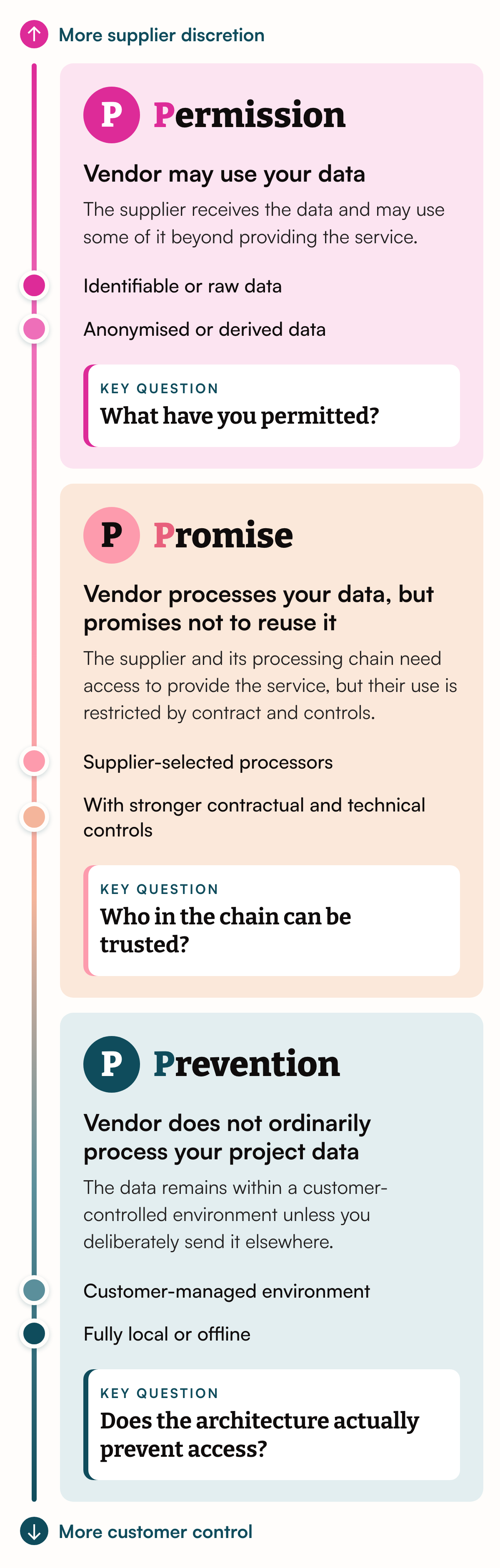
To make sense of these differences, we use a simple three-part framework: Permission, Promise and Prevention. These are not rigid categories but positions on a continuum. The same product may sit in different places depending on the feature, the type of data involved, or how it is deployed. What matters is what happens to your data in practice: who receives it, what they are allowed to do with it, and how much control you retain.
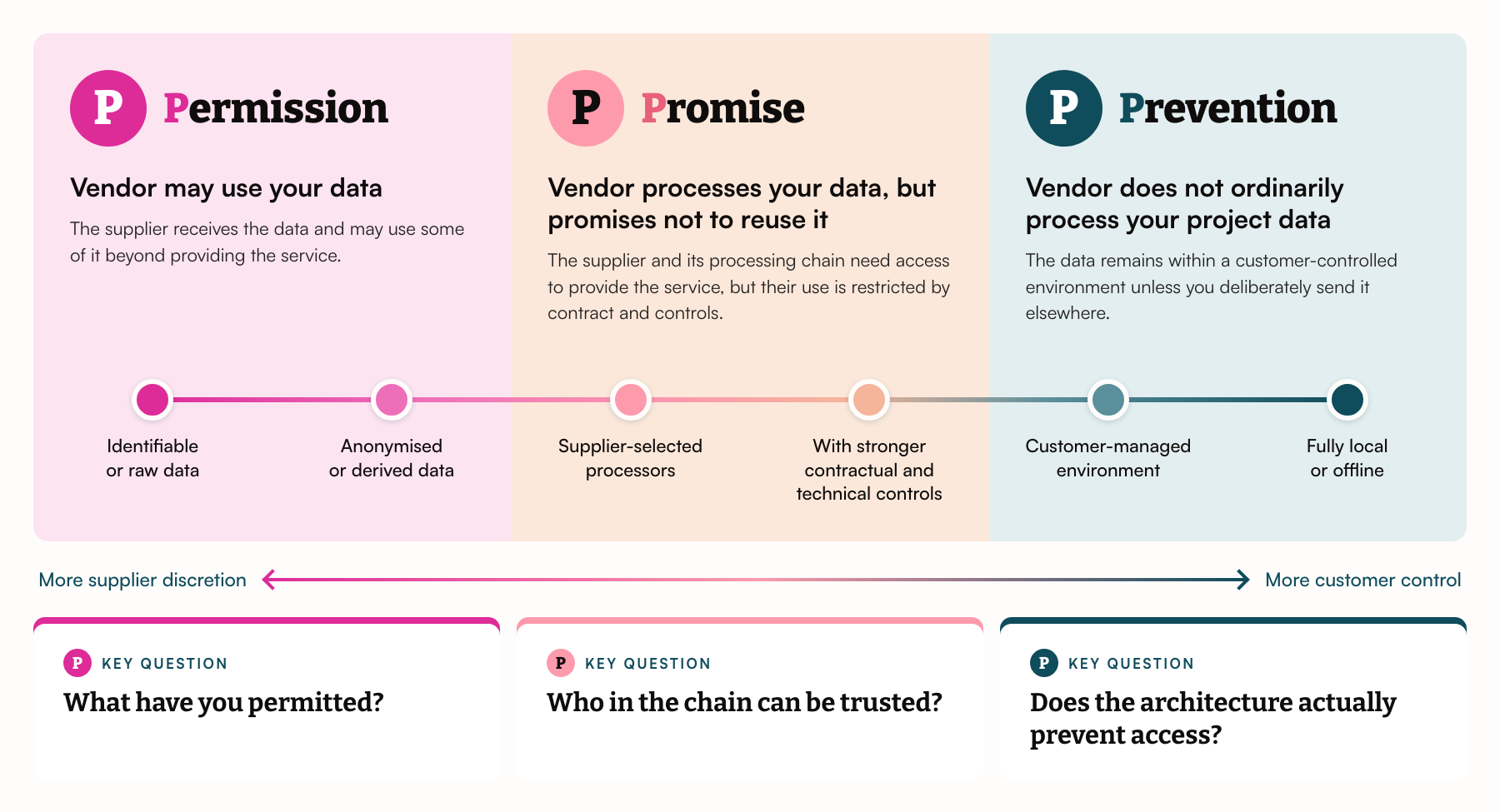
Under this model, the software provider can use customer data for purposes beyond delivering the service. These may include AI training, product development, evaluation or benchmarking. This isn’t necessarily a problem. A customer may willingly agree to share its data in exchange for better functionality, early access to new features or more favourable commercial terms. What matters is the scope of that permission: which data can be used, for what purposes, for how long, and whether it can be combined with information from other customers.
Security certifications don’t answer these questions. SOC 2 reports and ISO/IEC 27001 certificates provide assurance about how a company manages information security, but they don’t determine what the supplier is contractually allowed to do with customer data. The same applies to data residency: knowing where information is stored doesn’t tell you how it may be used. A supplier can comply with its security obligations while making extensive use of customer information, provided that use is authorised by the agreement.
Security protects data from unauthorised use. It does not limit authorised use.
One of the more complicated aspects of data permissions is how suppliers define anonymous or derived data. A provider may confirm that the original file belongs to the customer while retaining the right to use information described as anonymised, aggregated, de-identified, pseudonymised or derived. These terms describe different ways of transforming data, but they don’t necessarily tell us how much commercially valuable information remains.
Consider a set of construction drawings with the project name, address, client, architect and title block removed. The project may be difficult to identify, but the drawings still reveal wall geometry, structural solutions, product specifications, dimensions and connection details. If the drawings were part of a priced tender, the quantities, package structure and productivity assumptions may remain even after the monetary values have been removed. The project’s identity may be hidden while much of the knowledge that makes it commercially valuable remains intact.
This distinction matters because different organisations have different things to protect. A privacy team may focus on preventing the identification of individuals. A contractor may want to protect its pricing strategy or construction methods. An architect may want to protect a repeatable design solution, while a manufacturer may be concerned about proprietary fabrication details. Anonymisation can be effective for one purpose without addressing the others.
The same applies to derived data. A software provider may delete the original PDF while retaining extracted text, measurements, classifications, user corrections or other outputs that preserve valuable technical knowledge. Whether that information can be reused, combined with other datasets or incorporated into future products is therefore as important as what happens to the original document.
When a supplier says it uses only anonymous data, the practical question is what that actually means. What information has been removed? What remains? Can the data still reveal commercially sensitive methods or decisions? And does the customer’s right to delete its information extend to the datasets and models created from it?
Questions to ask about anonymised data
A customer may be perfectly comfortable allowing its data to help improve an AI model. But in construction, project data rarely belongs to one company alone. A tender pack may contain drawings created by architects and engineers, specifications written by consultants, specialist subcontractor designs, manufacturer details, supplier quotations and information provided by the client under project-specific agreements.
A contractor may have every right to use this material to price, coordinate and deliver a project. That doesn’t necessarily give it the right to authorise its use for AI training, commercial benchmarking or the development of products that will be used by other companies. The exact permissions depend on the underlying contracts and appointments, which may restrict how information can be shared or reused.
This creates a potential problem when accepting software terms. Some construction technology providers explicitly require customers to confirm that they have the necessary rights to authorise additional uses of the data they upload.
| Supplier | What the customer is asked to confirm | Why it matters |
|---|---|---|
| Togal.AI | The customer has “all necessary rights” in the content to grant Togal.AI the stated right to use it. | The customer is taking responsibility for having authority to grant that use. |
| qbiq | The customer has obtained “all the required consents and authorizations” for qbiq’s stated uses. | Agreeing to the terms assumes those permissions already exist. |
| PlanRadar | The customer warrants that it has “all necessary rights, approvals and consents” for the Customer Data licence. | The software agreement cannot itself give the customer rights it did not already hold. |
Accepting a software provider’s terms may authorise that provider to use the information, but it cannot create rights the customer never had. Where project data includes material created or supplied by other parties, agreeing to those terms could mean granting permissions the customer was never entitled to grant.
You may be willing to donate the knowledge. You may not be authorised to make that donation.
Most enterprise construction software sits somewhere in this broad middle category. The provider needs to receive and process project data to deliver its service, but its contractual rights are limited to that purpose. It may promise not to train AI models on customer files and require its subprocessors to follow the same restrictions. This is a reasonable model, provided the customer can establish what those promises cover and how they are enforced.
The evidence comes from several sources:
The value of each assurance depends on its scope. A SOC 2 report may cover only certain services and controls, while an ISO/IEC 27001 certificate applies to a defined information-security management system. Neither automatically covers every AI feature or external provider.
AI makes the boundaries of these promises harder to establish. A construction software company may truthfully state that it never trains on customer data, while its AI features send drawings or extracted information to Azure OpenAI, Amazon Bedrock, OpenAI, Anthropic or other external services. Those providers may also be contractually prohibited from using the information for training. Nevertheless, the customer is now relying on a wider chain of organisations, systems and agreements, each with its own processing and retention practices.
When the policy says “we do not train”, who is “we”?
Does the promise cover only the construction software provider, or also its affiliates, AI model providers, OCR services, evaluation tools and support systems? A supplier that identifies its processors, explains what information they receive, specifies retention periods and provides notice of changes gives customers a much clearer basis for assessing the risks. Vague references to third-party AI services leave considerably more unanswered.
The customer may believe it is entrusting its information to one supplier. In practice, delivering the service may involve a much wider network of providers, all of which need to be considered when assessing how the data is controlled
The third model shifts the focus from contractual promises to technical architecture. Project data stays on a local device, an on-premises server or infrastructure within the customer’s own cloud account. The customer controls administrative access, encryption keys and outbound connections, so the supplier does not ordinarily receive project files simply because its software is being used.
This distinction matters because a vendor-hosted “private workspace” or single-tenant environment does not necessarily provide the same level of control. If the supplier still manages administrators, encryption keys, backups or external connections, the customer continues to rely on the supplier’s promises about how its data will be handled. Prevention becomes meaningful when the customer can technically enforce those boundaries.
Customer-controlled infrastructure is not inherently risk-free. Local devices can be compromised, servers can be misconfigured, and security remains an operational responsibility. What changes is who controls the environment and the decisions about access, processing and sharing.
AI can also operate within a customer-controlled environment. Instead of sending project drawings or extracted information to an external model, an AI model can run on the customer’s own workstation, server or cloud infrastructure. Open-weight models make this possible, although keeping data contained still depends on how the system is configured and secured.
External AI services can be used alongside this approach, provided the transfer of data is deliberate and controlled. Two patterns are particularly relevant:
Prevention is about making the boundary visible and enforceable: where the AI runs, when data leaves, and who can access it.
There is no single answer to the question of how well construction software protects customer data. The same product may handle different types of information in different ways, depending on the feature, the processing chain and how the system is deployed. That is why the useful unit of analysis is the data flow, rather than the company or even the product.
The 3P framework provides a way to examine that flow. Start with Permission: what uses has the customer authorised, including the use of anonymised or derived information? Then examine Promise: who receives the data, and what contractual and technical controls restrict its use? Finally, consider Prevention: can the information remain within an environment the customer controls, and can the customer decide when it leaves?
These questions matter because data can be well protected against security breaches while still being legitimately used for AI training or product improvement. It can remain legally owned by the customer while passing through multiple providers. And it can be anonymised while retaining the technical and commercial knowledge that made it valuable in the first place.
The practical principle is simple:
Either bring the model to the data, or make the data’s departure explicit.
Part 3 turns the 3Ps into a practical checklist, with the tools to test a supplier: the 3P Data Control Check, a map for tracing your data, and a guide to what assurance signals do and do not prove.
About the research
The profiles are based on first-party terms, privacy policies, security pages, product documentation and AI notices reviewed on 20 August 2026. They are a public-document audit, not a penetration test or legal opinion.
Questions about the research, or about how your product handles customer data? We’d like to hear from you.